
Universidade Portucalense – Infante D. Henrique

Universidade Portucalense Infante D. Henrique is a cooperative higher education and scientific research establishment

News

Conferences on Pedagogical Innovation 

The University’s Pedagogical Innovation Office is organising the Third Cycle of Conferences on Pedagogical Innovation between April and June, with the aim of reflecting on and sharing good practices in the field of pedagogical innovation in Higher Education.   This edition highlights pedagogical strategies involving gamification, artificial intelligence, and the importance of flexible learning environments that foster student-centred active learning.   PROGRAMME   3 April | 3pm – 4:30pm Session 1: Pedagogical innovation in teacher professional development at Universidade Nova de Lisboa: the role of pedagogical training Patrícia Rosado Pinto, professor at Universidade Nova de Lisboa (UNL), will discuss the role of pedagogical training in teacher professional development, sharing the ongoing initiatives and projects at Universidade Nova de Lisboa.   22 May | 3pm – 4:30pm Session 2: How to improve the learning experience through gamification and artificial intelligence? Adelina Moura, researcher at LabTE at the University of Coimbra, will discuss how gamification and artificial intelligence contribute to improving students’ learning experience.   12 June | 3pm – 4:30pm Session 3: Flexible Learning Environments (AET): how to articulate the dimensions of space, pedagogy, and technology? Vânia Carlos, professor at the University of Aveiro, will present examples of flexible learning environments, reflecting on how to articulate the dimensions of space, pedagogy, and technology.   Registration Poster

“The poster in the history of advertising in Portugal” 

Eduardo Cintra Torres is the guest speaker at the seminar “The poster in the history of advertising in Portugal,” on 12 April at 11am in room 202.   In the words of the university professor, researcher, journalist, and critic for the press and television: “A journey through the history of the advertising poster in Portugal allows us to understand its graphic and aesthetic evolution, but also its cultural and social context. This profusely illustrated presentation covers the known period of the documented poster, from the 17th century to the 21st century, resulting from the author’s research over almost five years for the publication of “História da Publicidade em Portugal” and “História Ilustrada da Publicidade em Portugal,” published in November 2023.”   This is the first seminar of the seminar cycle “Paths of Development.”

Over 23 years old

The first phase of registration for the Special Higher Education Access and Entrance Exams for those over 23 years of age who wish to apply to the 15 first-cycle programmes at Universidade Portucalense will be open from 8 to 26 March.

Psychology and Education in the Age of Innovation

  “Psychology and Education in the Age of Innovation: Challenges and Interfaces with Technologies” is the theme of the 6th Psychology and Education Week, which runs from 11 to 14 March. On 11 March there will be a round table with experts from the fields of psychology and education who will discuss topics such as Artificial Intelligence and Human Rights, Augmented Reality, and Cybersecurity. On 12 March, there will be 12 workshops with 12 guest experts on a variety of topics, including the impact of social media on young people, school conflicts, communication and leadership, and crisis intervention, among others. Two “UPT Talks” are planned for 13 March, with researchers who will discuss ageing, mental health, and technology. On 14 March, the final-year students of the Clinical and Health Psychology master’s degree will present their dissertation works while the Social Education bachelor’s degree students and professors will share their training and preparation journeys for the job market.  

Universidade Portucalense establishes agreement with the Brazilian judiciary

Universidade Portucalense and the Court of Justice of Paraíba, through the Escola Superior da Magistratura, Brazil, signed a General Cooperation Agreement on 27 February, the main purpose of which is to establish reciprocal relations in the academic, scientific, and cultural spheres. Some of the anticipated activities are the mobility and training of professors, researchers, and students, the organisation of international programmes and conferences, and the promotion of scientific publications. Through mobility programmes and joint scientific events, students will have access to new opportunities for professional and academic development, which are essential for meeting the demanding challenges of the global job market. With this partnership, Universidade Portucalense reinforces its commitment to the continuous improvement of teaching and learning processes, the sharing of innovative practices, and specialised knowledge.

Job Fair brings together companies and institutions in March

On 21 March, more than 30 companies and institutions are expected at the “Careers UPT” Job Fair, from 10am to 5pm, in the Infante Hall. Solverde, Infineon, PWC, Salvador Caetano, Nuno Cerejeira Namora & Marinho Falcão Advogados are among the names already confirmed. This is an opportunity for final-year students and young graduates to find out about and apply for various jobs and internships.  This 11th edition will feature talks with former students from different training areas about employability and the challenges associated with the first steps in professional life.  

Giving new life to unused IT equipment

From 5 February to 29 April, Universidade Portucalense promotes a campaign to collect unused IT equipment as part of the ReBOOT project, which aims to repair 600 computers and deliver them to the Private Social Solidarity Institutions of the Porto Municipal Social Network.  Therefore, students and staff can deliver to the library desktops and laptops, from 2010 onwards, with the following minimum specifications: Intel i3 and Core 2 Duo processors, AMD A4 processor; Windows 7 operating system; 2GB RAM memory; and also, LCD or thin monitors. With the motto “Repair your computer. Transform the world,” this project, launched in June last year, has already collected almost 500 pieces of computer equipment which, instead of being discarded, have already been recovered and reintroduced into the cycle of use, contributing to the environmental and economic sustainability of the region. ReBOOT is an initiative of the Municipality of Porto and has the collaboration of Porto Digital, European Recycling Platform Portugal, LIPOR, Circular Economy Portugal, and Porto Ambiente, as well as the support of the Faculty of Engineering of the University of Porto, the Instituto Superior de Engenharia do Porto, Universidade Portucalense, and UPTEC.  

Donating blood saves lives!

On 23 April, the Universidade Portucalense community is invited to take part in a blood donation campaign, organised by RES-UPT  together with the Portuguese Blood and Transplantation Institute. Blood is vital for hospital treatments and procedures and plays a crucial role in maternal and neonatal care. A simple gesture can save lives! The blood collection will take place between 2pm and 7pm, in rooms 209 and 210.  

Academic Motivation in Higher Education: Challenge or Opportunity?

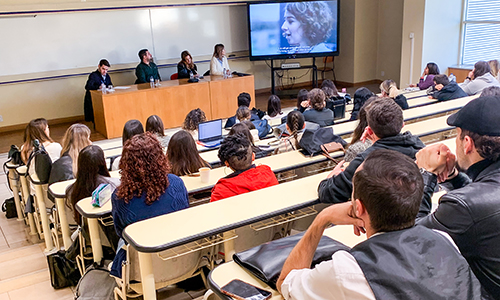
Universidade Portucalense will host the round table “Academic Motivation in Higher Education: Challenge or Opportunity?” on 1 March, at 11am, in the Aula Magna Room. This will be an opportunity for students, teachers, and leadership to share experiences and debate perspectives on how to promote and sustain student motivation throughout their academic journeys, with the aim of inspiring new approaches and collaborations that benefit the academic community The initiative was organised by the “Psychology of Motivation” students, a curricular unit in the Psychology degree, with the support of the Student Support Office and the Pedagogical Innovation Office. A video on academic motivation in Higher Education, shot by the students, will be shown as well as a mural of the work done as part of the curricular unit.

Scroll to top